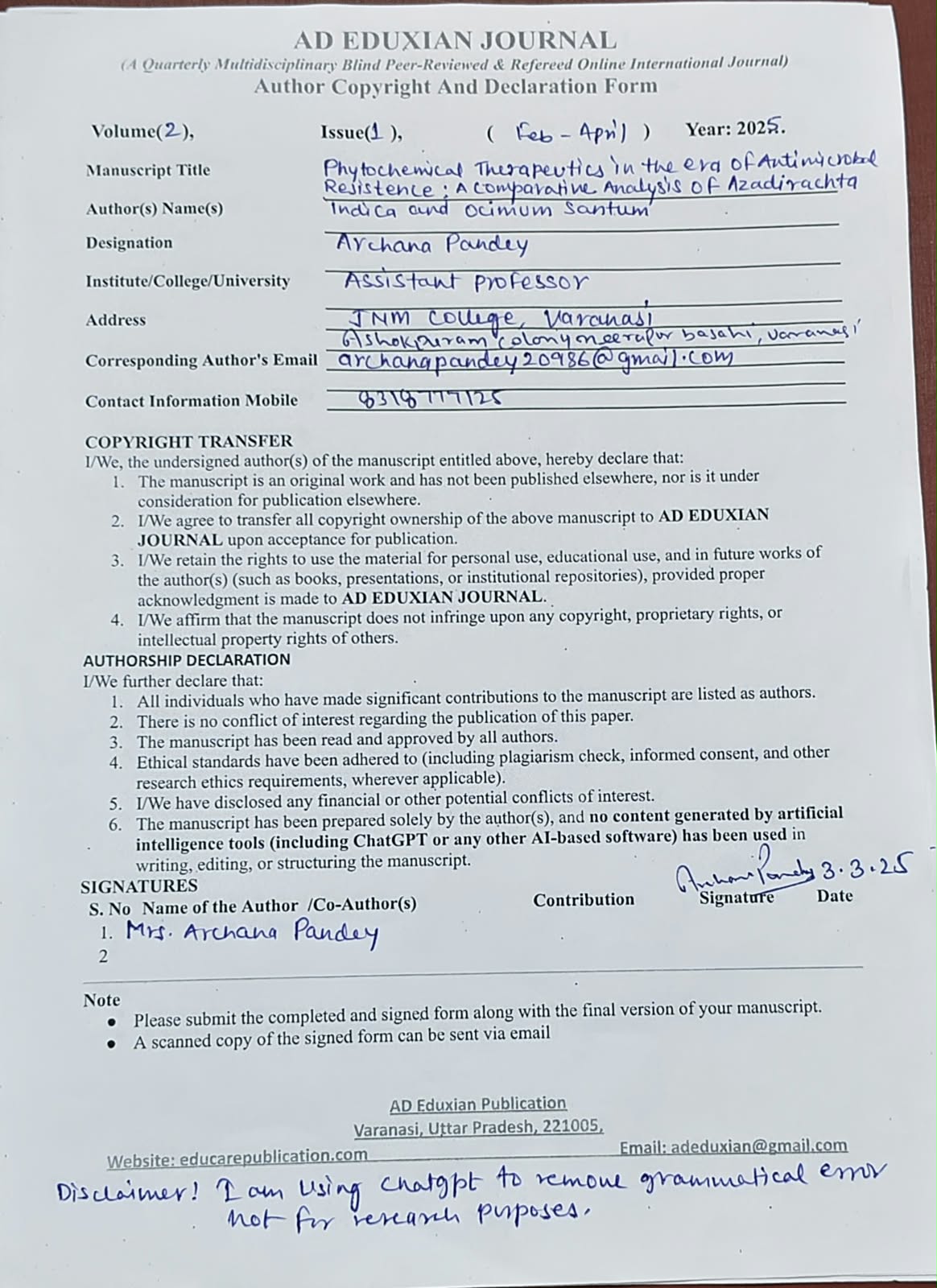
Phytochemical Therapeutics in the Era of Antimicrobial Resistance: A Comprehensive Analysis of Azadirachta indica and Ocimum sanctum
Acceptance: 04/04/2025
Published: 06/04/2025
Abstract
The global rise of antimicrobial resistance (AMR) demands novel agents against multidrug-resistant (MDR) pathogens. This review examines the antimicrobial potential of Azadirachta indica (Neem) and Ocimum sanctum (Tulsi), transitioning them from ethnomedicine to molecular pharmacognosy. Neem's limonoids (e.g., azadirachtin, nimbolide) and Tulsi's phenolics (e.g., eugenol) disrupt bacterial membranes, inhibit enzymes like DNA gyrase, and eradicate biofilms. Eugenol acts as an efflux pump inhibitor (EPI), re-sensitizing MDR strains such as Staphylococcus aureus via NorA blockade. Green nanotechnology, including silver nanoparticles from these plants, enhances bioavailability. Despite standardization challenges, these botanicals offer safe, synergistic candidates for next-generation therapies.
Keynote: Antimicrobial Resistance (AMR), Phytochemical Therapeutics, Azadirachta indica, Ocimum sanctum, Antimicrobial Activity
Post Views: 1
Author Name:
Archana Pandey
Pages:
494-515
DOI Number:
10.5281/zenodo.22994258
Country:
India
Orcid:
Full Article
Reference
SUSTAINABLE SOLUTIONS: Antimicrobial activity of neem and tulsi leaf extracts against environmental microbial threats. (n.d.). ResearchGate. https://www.researchgate.net/publication/383458914_SUSTAINABLE_SOLUTIONS_ANTIMICROBIAL_ACTIVITY_OF_NEEM_AND_TULSI_LEAF_EXTRACTS_AGAINST_ENVIRONMENTAL_MICROBIAL_THREATS
Exploring phytochemicals for combating antibiotic resistance in microbial pathogens. (n.d.). PubMed Central. https://pmc.ncbi.nlm.nih.gov/articles/PMC8334005/
The antimicrobial potential of the neem tree Azadirachta indica. (2022). Frontiers in Pharmacology. https://www.frontiersin.org/journals/pharmacology/articles/10.3389/fphar.2022.891535/full
Comparative study on antimicrobial activity of tulsi (Ocimum sanctum) and neem (Azadirachta indica) methanol extract. (2018). ResearchGate. https://www.researchgate.net/publication/329423954_Comparative_study_on_antimicrobial_activity_of_tulsi_Ocimum_sanctum_and_neem_azadirachta_indica_methanol_extract
Unveiling the neem (Azadirachta indica) effects on biofilm formation of food‑borne bacteria and the potential mechanism using a molecular docking approach. (n.d.). Plants. https://www.mdpi.com/2223-7747/13/18/2669
Antimicrobial activity of tulsi (Ocimum tenuiflorum …). (2016). Frontiers in Microbiology. https://www.frontiersin.org/journals/microbiology/articles/10.3389/fmicb.2016.00681/full
Comparison of the bioactivity of Tulsi and Neem plant extracts with their related endophytic actinomycetes against ESBL producer. (n.d.). Sciforum. https://sciforum.net/manuscripts/7262/slides.pdf
Evaluation of efflux pump inhibitory activity of some plant extracts and using them as … (2023). Journal on Antimicrobial Chemotherapy (article on PubMed Central). https://pmc.ncbi.nlm.nih.gov/articles/PMC9897506/
Herbal based inhibitors against efflux pumps in antibiotic resistant bacteria: A mini review. (2021). ResearchGate. https://www.researchgate.net/publication/351693966_Herbal_based_inhibitors_against_efflux_pumps_in_antibiotic_resistant_bacteria_A_mini_review
Megha, S., Indradhanush, & Venkatesha, D. (2023). Comparative study to determine antimicrobial property of neem leaves (Azadirachta indica) extracts using various solvents obtained from two geographical area. Journal of Medical Sciences and Health, 9(1), 57–63. https://doi.org/10.46347/jmsh.v9i1.22.317
The antimicrobial potential of the neem tree Azadirachta indica. (2022). Frontiers in Pharmacology. https://pmc.ncbi.nlm.nih.gov/articles/PMC9195866/
Kalita, C., Raja, D., Saikia, A., & Saikia, A. K. (2020). Antibacterial property of Azadirachta indica, Ocimum sanctum, and Vitex negundo against oral microbes. Journal of Conservative Dentistry, 22(6), 602–606. https://doi.org/10.4103/JCD.JCD_268_19
A comprehensive review on eugenol’s antimicrobial properties and industry applications: A transformation from ethnomedicine to industry. (2019). ResearchGate. https://www.researchgate.net/publication/332225537_A_comprehensive_review_on_eugenol’s_antimicrobial_properties_and_industry_applications_A_transformation_from_ethnomedicine_to_industry
Sarkar, S., Singh, R. P., & Bhattacharya, G. (2021). Exploring the role of Azadirachta indica (neem) and its active compounds in the regulation of biological pathways: An update on molecular approach. 3 Biotech, 11(4), 178. https://doi.org/10.1007/s13205-021-02745-4
Iqbal Nisa, R., Fazal, R., Mahmood, M. A., Hayat, A., Khalid, M., Mahmood, W., … Ullah, I. (n.d.). Antibacterial and antioxidant properties of Ocimum sanctum extracts against Streptococcus mutans and Escherichia coli. Journal of Medical & Health Sciences Review. https://jmhsr.com/index.php/jmhsr/article/download/153/version/152/211/1452Phytochemical-Therapeutics-in-the-Era-of-Antimicrobial-Resis.pdf
Antimicrobial properties of neem (Azadirachta indica): A comprehensive review of phytochemicals and mechanisms of action. (n.d.). International Journal of Scientific Research & Technology. https://www.ijsrtjournal.com/article/Antimicrobial+Properties+of+Neem+Azadirachta+Indica+A+Comprehensive+Review+of+Phytochemicals+and+Mechanisms+of+Action
Comparative evaluation of antimicrobial effectiveness and compressive strength in neem and lemongrass‑modified glass ionomer cement: An in vitro study. (2024). Journal of Conservative Dentistry. https://pmc.ncbi.nlm.nih.gov/articles/PMC11016290/
In‑vitro and in‑silico antibacterial activity of Azadirachta indica (Neem) methanolic extract, and identification of Beta.d‑Mannofuranoside as a promising antibacterial agent. (2022). Journal of Applied Microbiology. https://pmc.ncbi.nlm.nih.gov/articles/PMC9131563/
From clove oil to bioactive agents: Synthetic routes, antimicrobial and antiparasitic activities of eugenol derivatives. (2023). Molecules. https://pmc.ncbi.nlm.nih.gov/articles/PMC11559368/
Efflux pump inhibitors in controlling antibiotic resistance: Outlook under a heavy metal contamination context. (2023). Molecules, 28(7), 2912. https://www.mdpi.com/1420-3049/28/7/2912
Evaluation of the effects of hybrids of metronidazole and eugenol analogues as inhibitors of the Staphylococcus aureus NorA efflux pump: An in vitro and in silico analysis. (2023). ResearchGate. https://www.researchgate.net/publication/400832911_Evaluation_of_the_effects_of_hybrids_of_metronidazole_and_eugenol_analogues_as_inhibitors_of_the_Staphylococcus_aureus_NorA_efflux_pump_an_in_vitro_and_in_silico_analysis
Inhibition of Staphylococcus aureus efflux pump by O‑eugenol and its toxicity in Drosophila melanogaster animal model. (2022). Frontiers in Microbiology. https://pmc.ncbi.nlm.nih.gov/articles/PMC9325621/
In vitro and in silico inhibitory effects of synthetic and natural eugenol derivatives against the NorA efflux pump in Staphylococcus aureus. (2020). Journal of Applied Microbiology. https://pubmed.ncbi.nlm.nih.gov/32777574/
RND pump inhibition: In‑silico and in‑vitro study by eugenol on clinical strain of E. coli and P. aeruginosa. (2023). Microbial Pathogenesis. https://pmc.ncbi.nlm.nih.gov/articles/PMC10425304/
Phytochemical screening and antimicrobial activity of some medicinal plants against multi‑drug resistant bacteria from clinical isolates. (2013). Asian Pacific Journal of Tropical Biomedicine. https://pmc.ncbi.nlm.nih.gov/articles/PMC3660871/
Chandrappa, P. M., Dupper, A., Tripathi, P., Arroju, R., Sharma, P., & Sulochana, K. (2015). Antimicrobial activity of herbal medicines (tulsi extract, neem extract) and chlorhexidine against Enterococcus faecalis in endodontics: An in vitro study. Journal of International Society of Preventive & Community Dentistry, 5(Suppl 2), S89–S92. https://doi.org/10.4103/2231-0762.172952
Mistry, K. S., Sanghvi, Z., Parmar, G., & Shah, S. (2014). The antimicrobial activity of Azadirachta indica, Mimusops elengi, Tinospora cardifolia, Ocimum sanctum and 2% chlorhexidine gluconate on common endodontic pathogens: An in vitro study. European Journal of Dentistry, 8(2), 172–177. https://pmc.ncbi.nlm.nih.gov/articles/PMC4054046/
How efficacious are Neem, Tulsi, Guduchi extracts and chlorhexidine as intracanal disinfectants? A comparative ex vivo study. (2018). Journal of Conservative Dentistry, 21(4), 401–406. https://pmc.ncbi.nlm.nih.gov/articles/PMC5954265/
Jadheer Ahsan, K., Jaleel, A., Chaudhary, H., Bhattacharjee, S., Dan, S., & Dilshani, J. (2022). Comparative studies of antibacterial activity of Ocimum sanctum and Curcuma longa leaf extracts against E. coli and Staphylococcus aureus. International Journal of Health Sciences, 6(Suppl. 5), 3694–3701. https://doi.org/10.53730/ijhs.v6nS5.9322
Antibacterial and inhibitory activity of NorA and MepA efflux pumps of estragole complexed to β‑cyclodextrin (ES/β‑CD) in vitro against Staphylococcus aureus bacteria, molecular docking and MPO‑based pharmacokinetics prediction. (2024). Pharmaceutics. https://www.mdpi.com/1999-4923/16/11/1469
Misra, A., Ahmad, R., Trivedi, A., & Khan, M. A. (2017). Evaluation of in vitro cytotoxic activity of ethanolic extract of Azadirachta indica leaves as a function of pH on human breast cancer cell line MDA‑MB‑231. Journal of Basic and Clinical Pharmacy, 8(Suppl. 1), S72–S79. https://www.jbclinpharm.org/articles/evaluation-of-in-vitro-cytotoxic-activity-of-ethanolic-extract-of-azadiracta-indica-leaves-as-a-function-of-ph-on-human-breast-can.pdf
Stan, D., Enciu, A.-M., Mateescu, A. L., Ion, A. C., Brezeanu, A. C., Stan, D., & Tanase, C. (2021). Natural compounds with antimicrobial and antiviral effect and nanocarriers used for their transportation. Frontiers in Pharmacology, 12, Article 723233. https://doi.org/10.3389/fphar.2021.723233
Comparative evaluation of antimicrobial efficacy of silver nanoparticles infused with Azadirachta indica extract and chlorhexidine against red‑complex pathogens. (n.d.). ResearchGate. https://www.researchgate.net/publication/384261545_Comparative_Evaluation_of_Antimicrobial_Efficacy_of_Silver_Nanoparticles_Infused_with_Azadirachta_indica_Extract_and_Chlorhexidine_Against_Red-complex_Pathogens
Green synthesis of silver nanoparticles using Ocimum tenuiflorum and Azadirachta indica leaf extract and their antibacterial activity. (2023). ResearchGate. https://www.researchgate.net/publication/380390531_Green_synthesis_of_silver_nanoparticles_using_Ocimum_tenuiflorum_and_Azadirachta_indica_leaf_extract_and_their_antibacterial_activity
Botanically derived phytochemicals in antimicrobial spray … (n.d.). AGENS Journal. https://www.sagens.org/journal/agens/article/view/s202604010010
Baruah, H., Sarma, J., Mohan, P., Khargharia, S., Bora, P., Deka, P., Bora, D. P., Hussian, J., & Tamuly, S. (2021). Evaluation of cytotoxicity of Azadirachta indica A. Juss., Curcuma longa L. and Ocimum sanctum L. in BHK‑21 cell line. Annals of Phytomedicine, 10(2), 182–186. https://doi.org/10.21276/ap.2021.10.2.25
Baruah, H., Sarma, J., Mohan, P., Khargharia, S., Bora, P., Deka, P., Bora, D. P., Hussian, J., & Tamuly, S. (2021). Evaluation of cytotoxicity of Azadirachta indica A. Juss., Curcuma longa L. and Ocimum sanctum L. in BHK‑21 cell line. ResearchGate (PDF version). https://www.researchgate.net/publication/357879146_Evaluation_of_cytotoxicity_of_Azadirachta_indica_A_Juss_Curcuma_longa_L_and_Ocimum_sanctum_L_in_BHK-21_cell_line
Effect of Ocimum sanctum extract on leukemic cell lines: A preliminary in‑vitro study. (2020). Journal of Cancer Research and Therapeutics. https://pmc.ncbi.nlm.nih.gov/articles/PMC7269281/
Holy basil leaf extract decreases tumorigenicity and metastasis of aggressive human pancreatic cancer cells in vitro and in vivo: Potential role in therapy. (2013). Anticancer Research. https://pmc.ncbi.nlm.nih.gov/articles/PMC3700662/
Ravi Sikrodia, R., et al. (2020). Comparative in‑vitro antibacterial efficacy of the different common herbs and antibiotics against E. coli and S. aureus isolated from … International Journal of Current Microbiology and Applied Sciences, 9(2). https://www.ijcmas.com/9-2-2020/Ravi%20Sikrodia,%20et%20al.pdf
Writer Name
Archana Pandey
Pages
494-515
DOI Numbers
10.5281/zenodo.22994258
Our Social Networks

AD EDUXIAN Publication is dedicated to advancing educational research and providing innovative learning solutions. We offer a wide range of services including publishing, editing, design, and marketing to support authors and researchers in their academic and professional endeavors.
Never miss any important news. Subscribe to our newsletter.