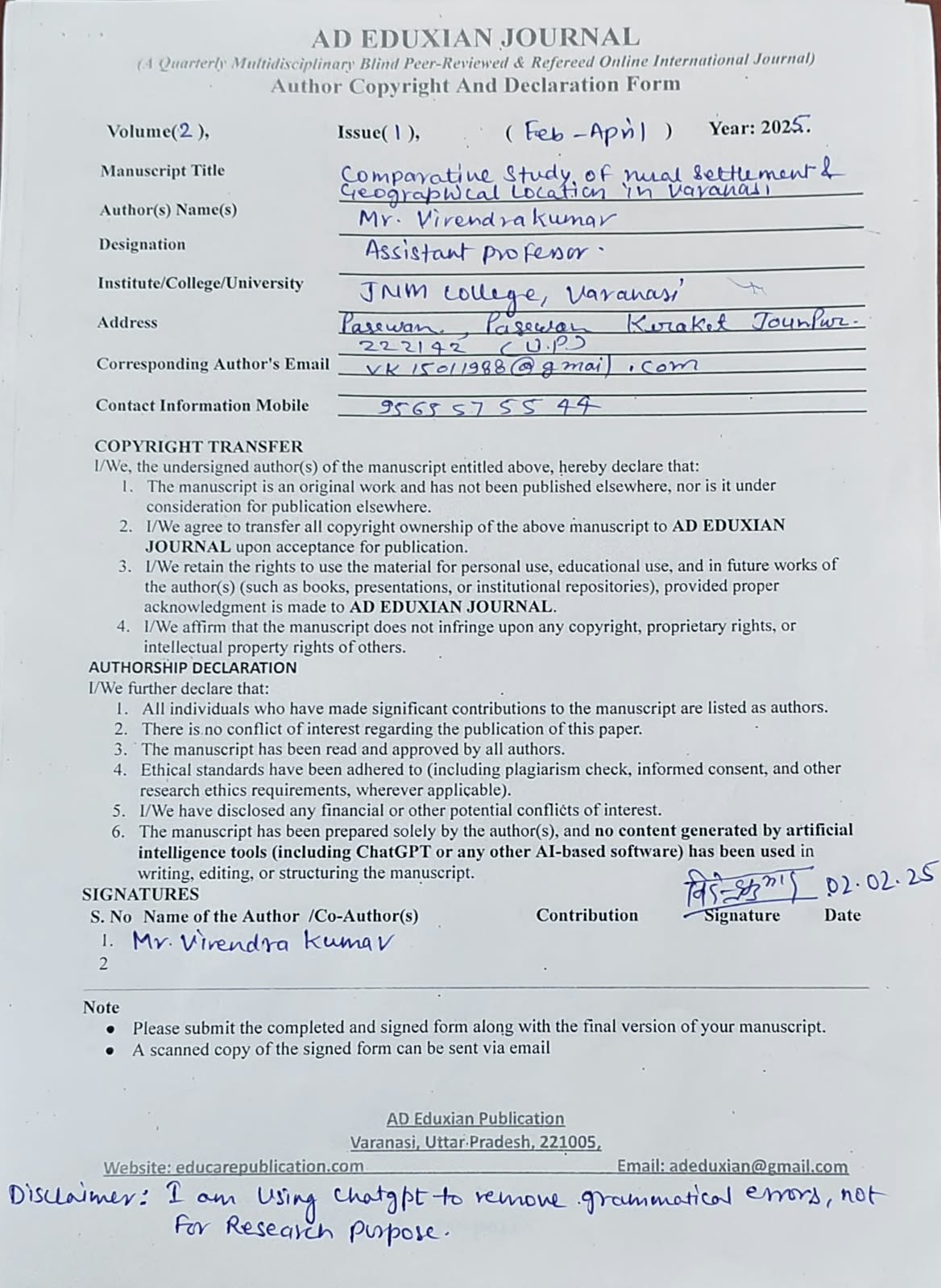
Comparative study of Rural Settlement and Geographical Location in Varanasi
Acceptance: 04/04/2025
Published: 06/04/2025
Abstract
This study examines the relationship between rural settlement patterns and geographical location in Varanasi district. It aims to analyze how physical factors such as topography, soil, water availability, and proximity to the Ganga River influence settlement distribution. A comparative approach is adopted to distinguish variations among settlements located in riverine, plain, and peripheral regions. The research uses both primary and secondary data to understand spatial organization, socio-economic conditions, and developmental disparities. The findings highlight that geographical factors significantly shape settlement morphology, accessibility, and livelihood patterns
Keynote: Rural Settlement, Geographical Location, Varanasi District, Settlement Patterns, Spatial Distribution, Ganga River, Topography, Soil, Water Availability, Settlement Morphology, Rural Development, Socio-Economic Conditions, Accessibility, Livelihood Patter
Post Views: 0
Author Name:
Mr. Virendra Kumar
Pages:
486-493
DOI Number:
10.5281/zenodo.22990183
Country:
india
Orcid:
Full Article
Reference
• Singh, R.L. (1971). India: A Regional Geography.
• Farmer, B.H. (1964). Agricultural Colonization in India.
• Census of India (2011).
• Government of Uttar Pradesh Reports
• Relevant journal articles on rural geography
Writer Name
Mr. Virendra Kumar
Pages
486-493
DOI Numbers
10.5281/zenodo.22990183
Our Social Networks

AD EDUXIAN Publication is dedicated to advancing educational research and providing innovative learning solutions. We offer a wide range of services including publishing, editing, design, and marketing to support authors and researchers in their academic and professional endeavors.
Never miss any important news. Subscribe to our newsletter.