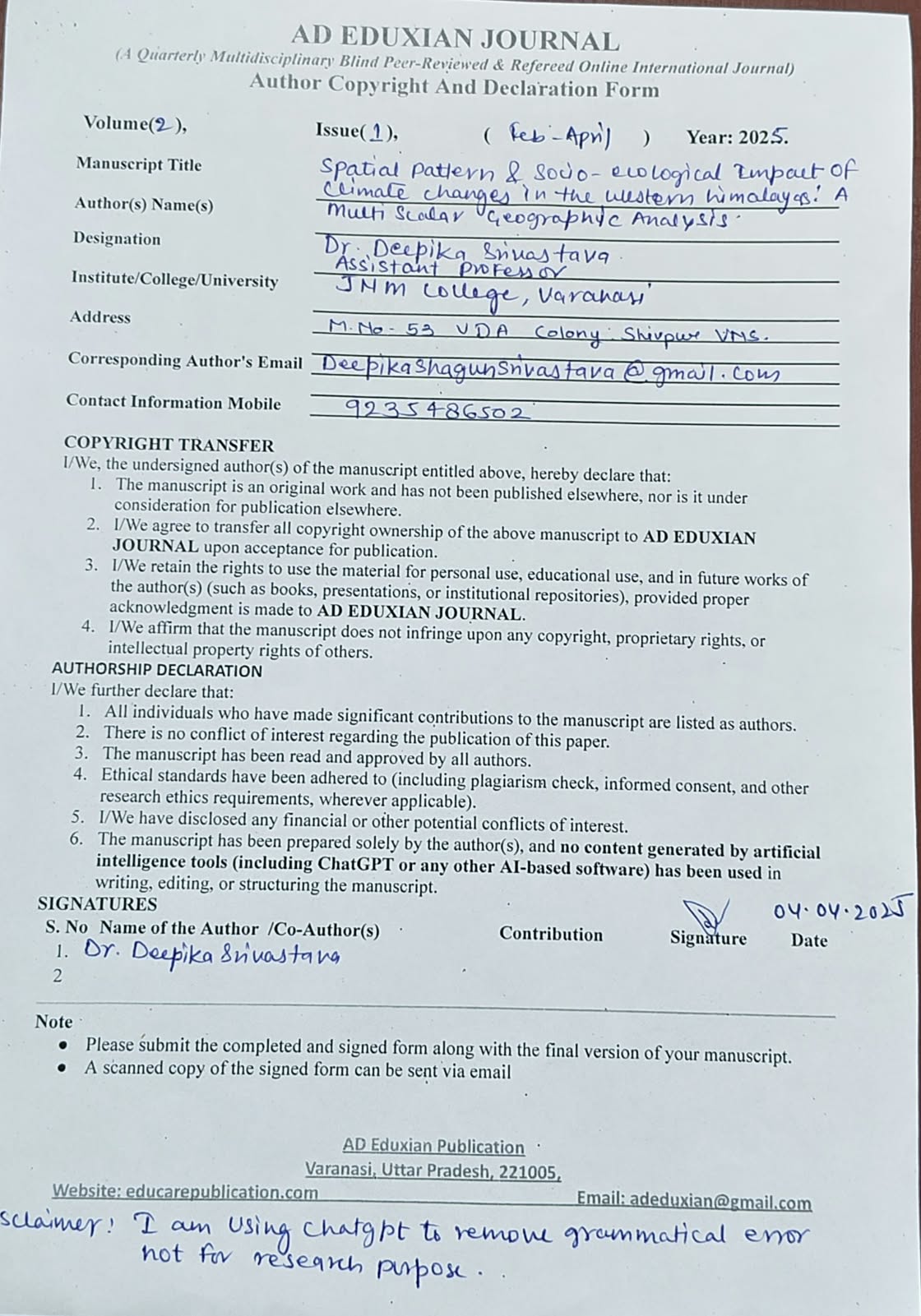
Spatial Patterns and Socio-Ecological Impacts of Climate Change in the Western Himalayas: A Multi-Scalar Geographic Analysis
Acceptance: 04/04/2025
Published: 06/04/2025
Abstract
Climate change represents one of the most significant environmental challenges of the 21st century, with profound implications for both natural systems and human societies. This study investigates the spatial dynamics and socio-ecological effects of climate change in the Western Himalayan region using a mixed-methods geographic approach. It integrates remote sensing data, climate models, and community-level vulnerability assessments to analyze changes in temperature, precipitation, glacial retreat, land use/land cover dynamics, and adaptive capacities of local populations. The research particularly addresses the knowledge gap concerning multi-scalar interactions between climatic processes and socio-economic responses. Preliminary findings suggest accelerated warming trends, differential impacts across altitudinal gradients, and varied adaptation strategies tied to local socio-economic conditions. The study contributes to geographic scholarship by offering an integrated framework combining physical and human geographic perspectives and proposes policy recommendations for resilience building.
Keynote: Climate Change, Western Himalayas, Spatial Patterns, Socio-Ecological Impacts, Geographic Analysis, Remote Sensing, Climate Variability, Glacial Retreat, Temperature Trends, Precipitation Changes, Land Use and Land Cover, Vulnerability Assessment, Adaptat
Post Views: 1
Author Name:
Dr. Deepika Srivastava
Pages:
516-522
DOI Number:
10.5281/zenodo.22995654
Country:
India
Orcid:
Full Article
Reference
IPCC. (2023). Climate Change 2023: The Physical Science Basis.
Bookhagen, B., & Burbank, D. W. (2010): Toward a complete Himalayan hydrological budget: Spatiotemporal distribution of snowmelt and rainfall and their impact on river discharge. Journal of Geophysical Research.
Shrestha, A. B., et al. (2012): Climate change and glacier retreat: Implications for water resources in the Himalayas Environmental Research Letters.
Adger, W. N. (2006): Vulnerability Global Environmental Change.
Turner, B. L., et al. (2003): A framework for vulnerability analysis in sustainability science. PNAS.
Adger, W. N. (2006): Vulnerability Global Environmental Change, 16(3), 268–281.
Beniston, M. et al. (2018): The impacts of climate change on mountain regions. Regional Environmental Change, 18(2), 349–364.
Bolch, T., et al. (2019): Status and change of the cryosphere in the extended Hindu Kush Himalaya region. The Hindu Kush Himalaya Assessment.
Gentle, P., et al. (2014): Vulnerability and adaptation to climate change in the Himalayas. Mountain Research and Development, 34(1), 1–10.
Immerzeel, W. W., et al. (2020): Importance and vulnerability of the world’s water towers. Nature, 577(7790), 364–369.
IPCC (2023). Climate Change 2023: The Physical Science Basis Cambridge University Press.
Köppen, W. (1936): Das geographische System der Klimate.
Pepin, N. C., et al. (2015): Elevation-dependent warming in mountain regions. Nature Climate Change, 5(5), 424–430.
Roy, P. S., et al. (2014): Land use and land cover change in India. Current Science, 107(2), 316–325.
Shrestha, A. B., et al. (2012): Climate change in the Hindu Kush-Himalayas. Environmental Research Letters, 7(1).
Singh, C., et al. (2019): Livelihood vulnerability and adaptation. World Development, 122, 1–14.
Turner, B. L., et al. (2003): A framework for vulnerability analysis. Proceedings of the National Academy of Sciences, 100(14), 8074–8079.
Writer Name
Dr. Deepika Srivastava
Pages
516-522
DOI Numbers
10.5281/zenodo.22995654
Our Social Networks

AD EDUXIAN Publication is dedicated to advancing educational research and providing innovative learning solutions. We offer a wide range of services including publishing, editing, design, and marketing to support authors and researchers in their academic and professional endeavors.
Never miss any important news. Subscribe to our newsletter.