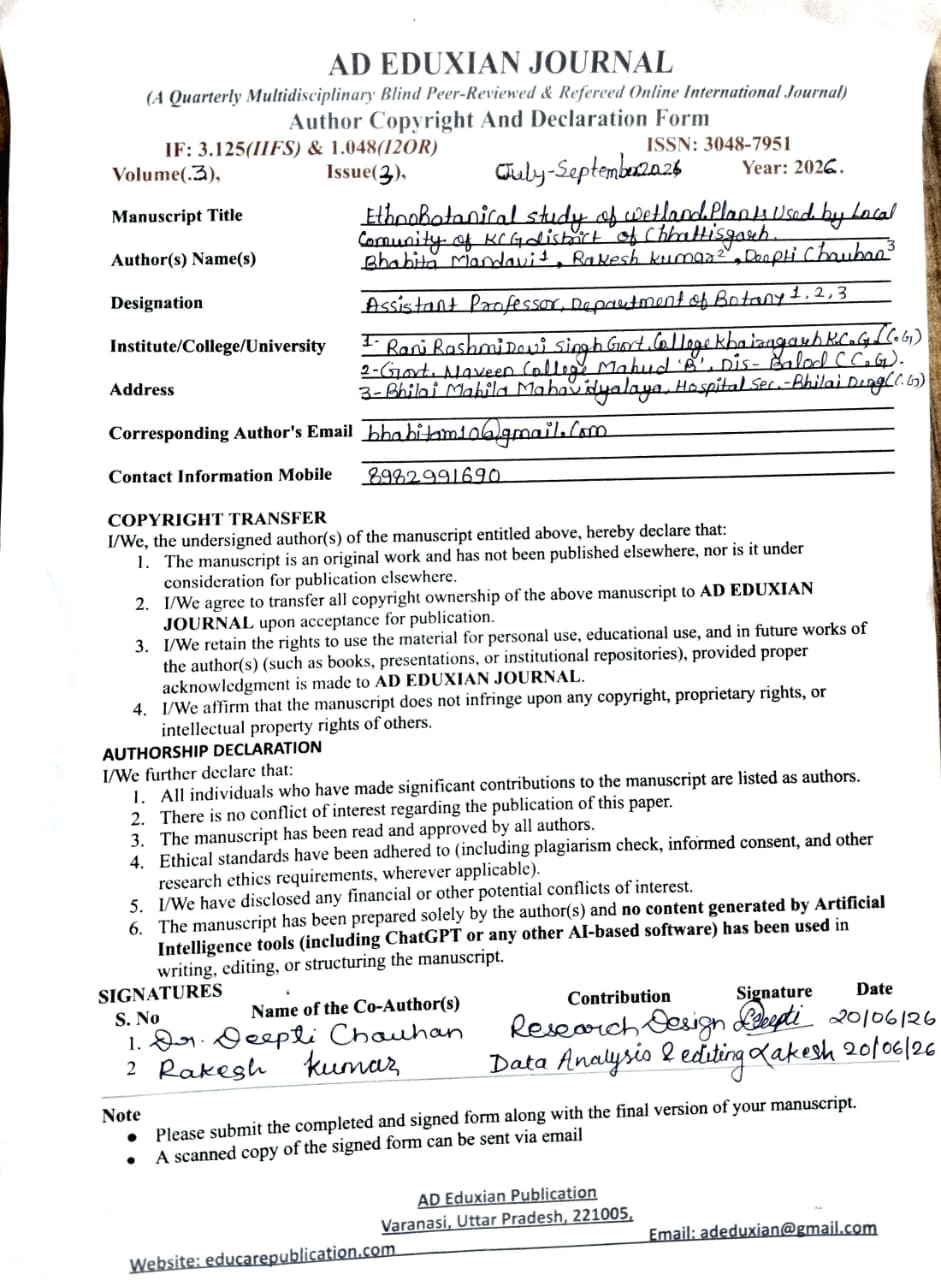
ETHNOBOTANICAL STUDY OF WETLAND PLANTS USED BY LOCAL COMMUNITY OF KHAIRAGARH-CHHUIKHADAN-GANDAI (KCG) DISTRICT OF CHHATTISGARH
Acceptance: 08/07/2026
Published: 17/08/2026
Abstract
Wetland ecosystems serve as a conduit between terrestrial and aquatic environments. The water bodies control the ecosystem, which is home to both plant and animal life. The wetland’s diverse species are mostly reliant on food supplies and habitat suitability. Wetlands are considered the richest habitat based on world biodiversity. These threatened ecosystems are currently in danger of going extinct because to urbanisation, industrialisation, and careless farming. The purpose of this research is to examine the connection between indigenous knowledge systems and biodiversity, with a particular emphasis on wetlands. Selected wetlands in different parts of the Khairagarh-Chhuikhadan-Gandai district of the state of Chhattisgarh were used for study. Highlighting the ethnobotanical significance of the vegetation found close to wetlands is the main goal. Floral sample were gathered from both land and water for the purpose of the study. In wetland habitats, several species including Ipomea aquatica, Nylwmbo, Trapa and Marsilea are frequently regarded as food. Some other key significant medicinal values are Andrographis paniculata, Barleria, Leucas aspera, Calotropis gigantea, Seena tora, Justicia adhatoda, Cyperus rotundus, and Hemidesmus indicus. Cynodon dactylon, Commelina benghalensis, Eragrostis tenella, Dicanthelium, and Echinochloa are example of plant species that are used as cow food and are essential to cultural properties and livelihoods. The flora found in wetlands improves water quality, provides refuge for wildlife, and is crucial to ecological stability.
Keynote: Wetland, Biodiversity, Indigenous Knowledge, ethnobotany, ecosystem.
Post Views: 23
Author Name:
Bhabita Mandavi, Rakesh Kumar, Deepti Chauhan
Pages:
21-42
DOI Number:
10.5281/zenodo.21970952
Country:
india
Orcid:
Full Article
Reference
REFERNCES:
Amenu, B. T., & Mamo, G. S. (2018). Review on wetland ecosystem destruction. International Journal of Scientific Research in Civil Engineering, 2(2), 5-15.
Arya, A. K., Joshi, K. K., & Bachheti, A. (2020). A review on distribution and importance of wetlands in the perspective of India. Journal of Applied and Natural Science, 12(4), 710-720.
Bassi, N., Kumar, M. D., Sharma, A., & Pardha-Saradhi, P. (2014). Status of wetlands in India: A review of extent, ecosystem benefits, threats and management strategies. Journal of hydrology: Regional studies, 2, 1-19.
Bharos, A. M. K., Bharos, A., Verma, J., Bux, F., & Verma, D. (2023). Winter Avian species of Gatapar wetland & their food guild, District Khairagarh, Chhattisgarh, India. Newsletter for Birdwatchers, 63(2), 17-23.
Chauhan, D., Shrivastava, A. K., & Patra, S. (2014). Diversity of leafy vegetables used by tribal peoples of Chhattisgarh, India. Int J Curr Microbiol App Sci, 3(4), 611-622.
Dashahre, A. K., Wasnik, A., Bisen, Y., & Shankar Yadav, H. (2020). Grasses Diversity of Balaghat District, Central India, Madhya Pradesh, With Special Reference to Their Utility. International Journal of Scientific Development and Research, 5(4), 376-381.
Dubey, R. K., Devi, J., Prasad, I., Rai, N., & Behera, T. K. (2024). Characterization of water chestnut (Trapa natans L.) genotypes for yield and nutritional traits using PCA analysis. Vegetable Science, 51(02), 292-300.
George, J. P., Ujjaini, M. M., & Yadav, K. C. (2015). Status of Wetlands and Wetland Birds in New Raipur, in Raipur, Chhattisgarh, India. International Journal of Multidisciplinary Research and Development, 2(9), 378-381.
Gupta, N., Sahu, D. P., Hassan, M., & Ahirwar, R. C. (2023). Phytochemical and pharmacological analysis of some selected traditional medicinal plants of Chhattisgarh. BioGecko, 12(2), 840-863.
Hooker, J. D. (1890). The flora of British India (Vol. 5). L. Reeve.
Maitry, A., Sharma, D., Shah, P., Baretha, G., & Patil, G. (2023). Assessment of wetland ecosystem services (RAWES approach) in urban settlement area: A case study of Bilaspur, Chhattisgarh, India. Indian Journal of Ecology, 50(4), 954-962.
Mandlik, P. (2015). Leucas aspera: Medicinal plant review. International Research Journal of Multidisciplinary Studies, 1(3), 153-159.
Nayar, R. (2020). Impact on Ecological, Economical and Environmental Ecosystem by The Wetland Part of Religious Ponds of Ratanpur in Chhattisgarh, India, A Survey. SSRG International Journal of Nursing and Health Science 6(1), 50-57.
Prasad, S. N., Ramachandra, T. V., Ahalya, N., Sengupta, T., Kumar, A., Tiwari, A. K., … & Vijayan, L. (2002). Conservation of wetlands of India-a review. Tropical Ecology, 43(1), 173-186.
Rai, P. K., & Singh, J. S. (2020). Invasive alien plant species: Their impact on environment, ecosystem services and human health. Ecological indicators, 111, 106020.
Singh, R., Choudhary, J., Mehra, R., Kumar, H., Kaushik, R., & Kumar, N. (2019). Preparation and evaluation of kamal kakadi (lotus stem) based deep fried chips. J. Agric. Engg. and Food Technol, 6, 96-98.
Swarnkar, A. K., Bajpai, S., & Ahmad, I. (2024). Study on the performance of wetlands and impact on water quality in a densely populated urban area in Amanaka, Raipur, Chhattisgarh, India. Advances in Environmental Technology, 10(1), 1-11.
Tiwari, A. K., Mehta, R., & Sen, K. K. (2022). Traditional health practices among the Tribal Belt of Chhattisgarh, India: an indigenous knowledge from indigenous peoples. International Journal of Pharmaceutical Research and Allied Sciences, 11(4), 95-106.
Verma D. M., Pant P. C. & Hanfi M. I. (1985) Flora of Raipur, Durg and Rajnandgaon. Flora of India Series 3. Botanical Survey of India Publication, Howrah.
Verma, D. M., Balakrishnan, N. P., & Dixit, R. D. (1993). Flora of Madhya Pradesh Vol. I. Botanical Survey of India, Calcutta, 280.
Xu, X., Chen, M., Yang, G., Jiang, B., & Zhang, J. (2020). Wetland ecosystem services research: A critical review. Global Ecology and Conservation, 22, e01027.
Writer Name
Bhabita Mandavi, Rakesh Kumar, Deepti Chauhan
Pages
21-42
DOI Numbers
10.5281/zenodo.21970952
Our Social Networks
AD EDUXIAN Publication is dedicated to advancing educational research and providing innovative learning solutions. We offer a wide range of services including publishing, editing, design, and marketing to support authors and researchers in their academic and professional endeavors.
Never miss any important news. Subscribe to our newsletter.