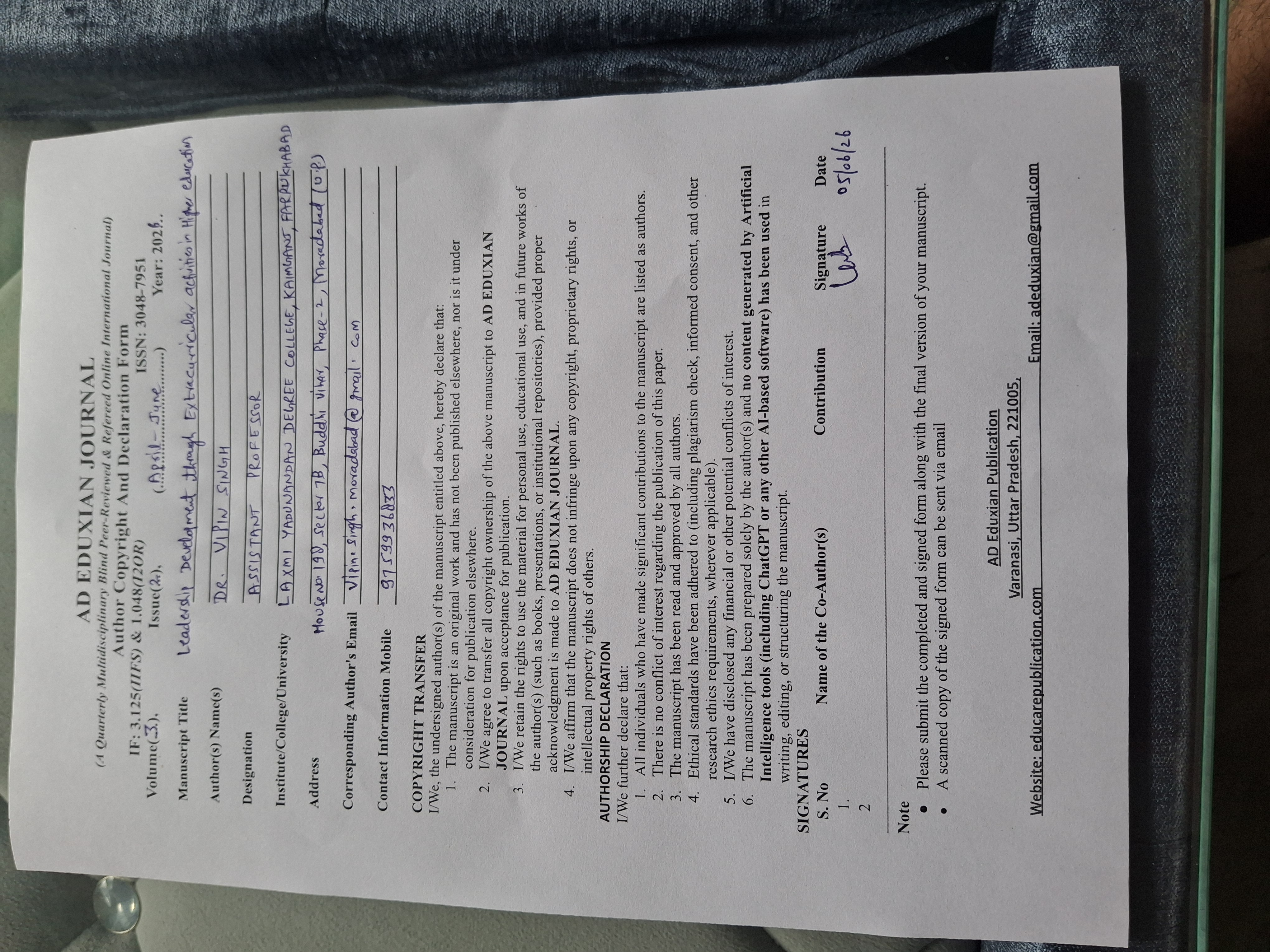
Leadership Development through Extracurricular Activities in Higher Education
Acceptance: 04/05/2026
Published: 06/06/2026
Abstract
Leadership is one of the main objectives of higher education and equipping students to become effective and productive citizens in the workplace and in life. Extra-curricular activities offer opportunities for the students to apply the knowledge gained in the classroom and to develop leadership skills such as ethics, communication, resilience, and collaboration. The method of this research is conceptual with a qualitative approach to explore the influence of these co-curriculars on leadership development. Theories related to experiential learning, social relationships, and transformational leadership are used to develop understanding of how these activities contribute to a holistic growth, how they can be barriers to implementation, and how they can be incorporated into leadership programs. It illustrates the possible role of cultural societies, N.C.C. and N.S.S. programmes in the country in building moral leaders in the Indian context.
Keynote: Leadership, Higher Education, Extracurricular Activities, Qualitative Approach, Holistic Growth
Post Views: 57
Author Name:
Dr. Vipin Singh
Pages:
302-307
DOI Number:
10.5281/zenodo.20567434
Country:
India
Orcid:
Full Article
Reference
Astin, A. W. (1999). Student involvement: A developmental theory for higher education. Journal of College Student Development, 40(5), 518–529.
Bass, B. M. (1990). From transactional to transformational leadership: Learning to share the vision. Organizational Dynamics, 18(3), 19–31.
Eime, R. M., Young, J. A., Harvey, J. T., Charity, M. J., & Payne, W. R. (2013). A systematic review of the psychological and social benefits of participation in sport. International Journal of Behavioral Nutrition and Physical Activity, 10(1), 135.
Kolb, D. A. (1984). Experiential learning: Experience as the source of learning and development. Prentice Hall.
Putnam, R. D. (2000). Bowling alone: The collapse and revival of American community. Simon & Schuster.
Youniss, J., & Yates, M. (1997). Community service and social responsibility in youth. University of Chicago Press.
Writer Name
Dr. Vipin Singh
Pages
302-307
DOI Numbers
10.5281/zenodo.20567434
Our Social Networks

AD EDUXIAN Publication is dedicated to advancing educational research and providing innovative learning solutions. We offer a wide range of services including publishing, editing, design, and marketing to support authors and researchers in their academic and professional endeavors.
Never miss any important news. Subscribe to our newsletter.