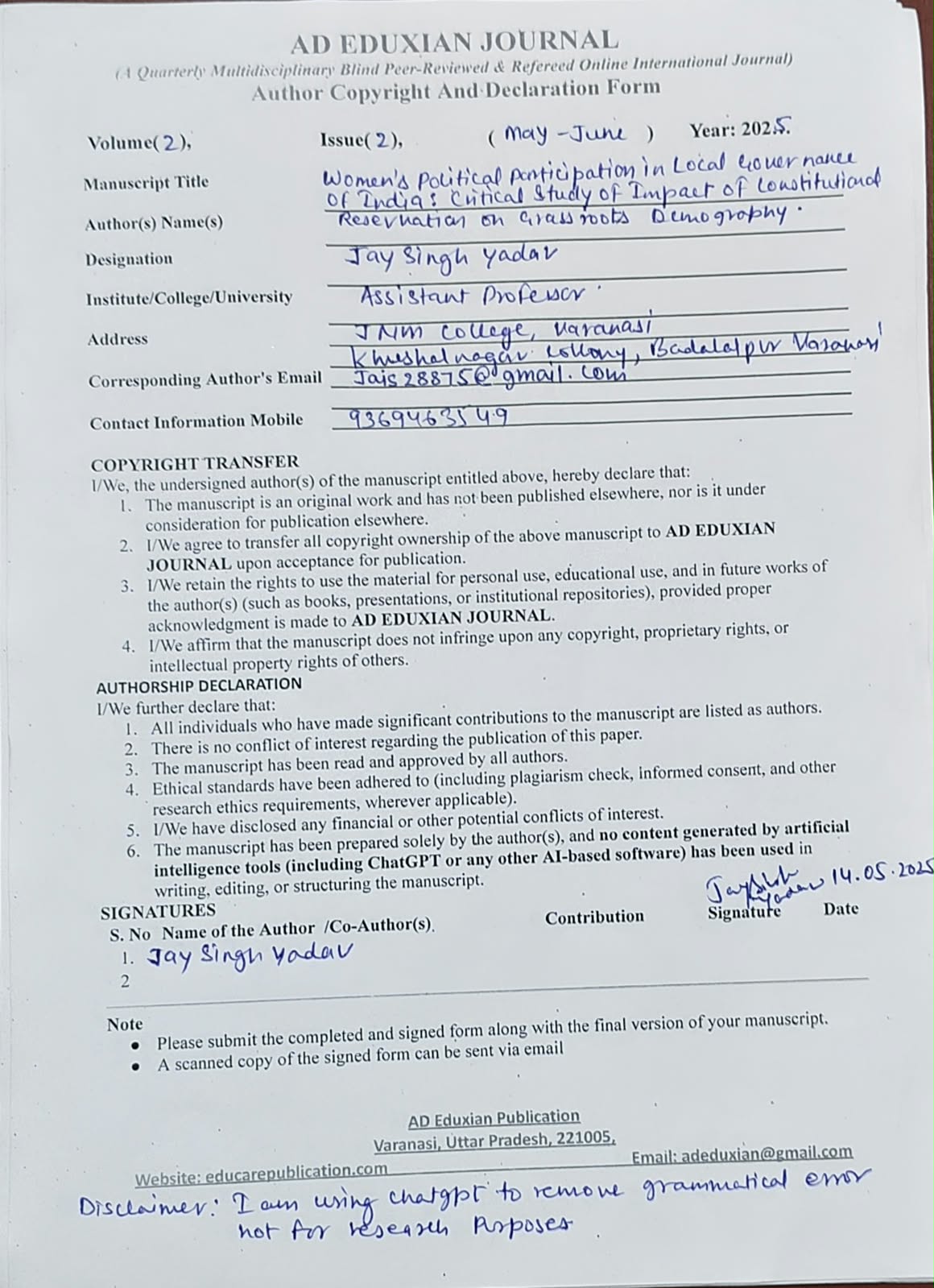
Women’s Political Participation in Local Governance in India: A Critical Study of the Impact of Constitutional Reservation on Grassroots Democracy
Acceptance: 27/08/2025
Published: 10/09/2025
Abstract
Women’s political participation is essential for democratic inclusiveness and gender justice. In India, the 73rd and 74th Constitutional Amendments (1992–93) marked a historic milestone by institutionalizing decentralized governance and mandating not less than one-third reservation for women in Panchayati Raj Institutions (PRIs) and Urban Local Bodies (ULBs). Several states later increased this reservation to 50%, making India home to the largest number of elected women representatives in the world. This research paper critically examines the constitutional framework, extent of participation, socio-economic determinants, challenges, and governance outcomes associated with women’s political participation at the grassroots level. The study argues that while reservation has ensured descriptive representation, substantive empowerment depends on education, economic independence, institutional support, and transformation of patriarchal social structures. The paper concludes that constitutional reservation has significantly deepened grassroots democracy but requires complementary reforms for sustained gender empowerment.
Keynote: Women, Political Participation, Panchayati Raj, Reservation, Grassroots Democracy, Gender Empowerment, India
Post Views: 1
Author Name:
Mr. Jay Singh Yadav
Pages:
268-274
DOI Number:
10.5281/zenodo.22955085
Country:
India
Orcid:
Full Article
Reference
Agarwal, B. (1997). Bargaining and gender relations. Feminist Economics,3(1),1–51.
Duflo,E.(2004). The impact of political reservation in India. Journal of Public Economics, 88(9–10), 1409–1434.
Jayal,N.G.(2006). Representing India. Palgrave Macmillan.
Kabeer,N.(1999). Resources, agency, achievements. DevelopmentandChange,30(3),435–464.
Ministry of Panchayati Raj. (2023). Annual Report. Government of India.
Pateman,C.(1970). Participation and democratic theory. Cambridge University Press. Phillips,
A. (1995). The politics of presence. Oxford University Press. Constitution of India (1992). 73rd & 74th Constitutional Amendment Acts.
Writer Name
Mr. Jay Singh Yadav
Pages
268-274
DOI Numbers
10.5281/zenodo.22955085
Our Social Networks

AD EDUXIAN Publication is dedicated to advancing educational research and providing innovative learning solutions. We offer a wide range of services including publishing, editing, design, and marketing to support authors and researchers in their academic and professional endeavors.
Never miss any important news. Subscribe to our newsletter.