
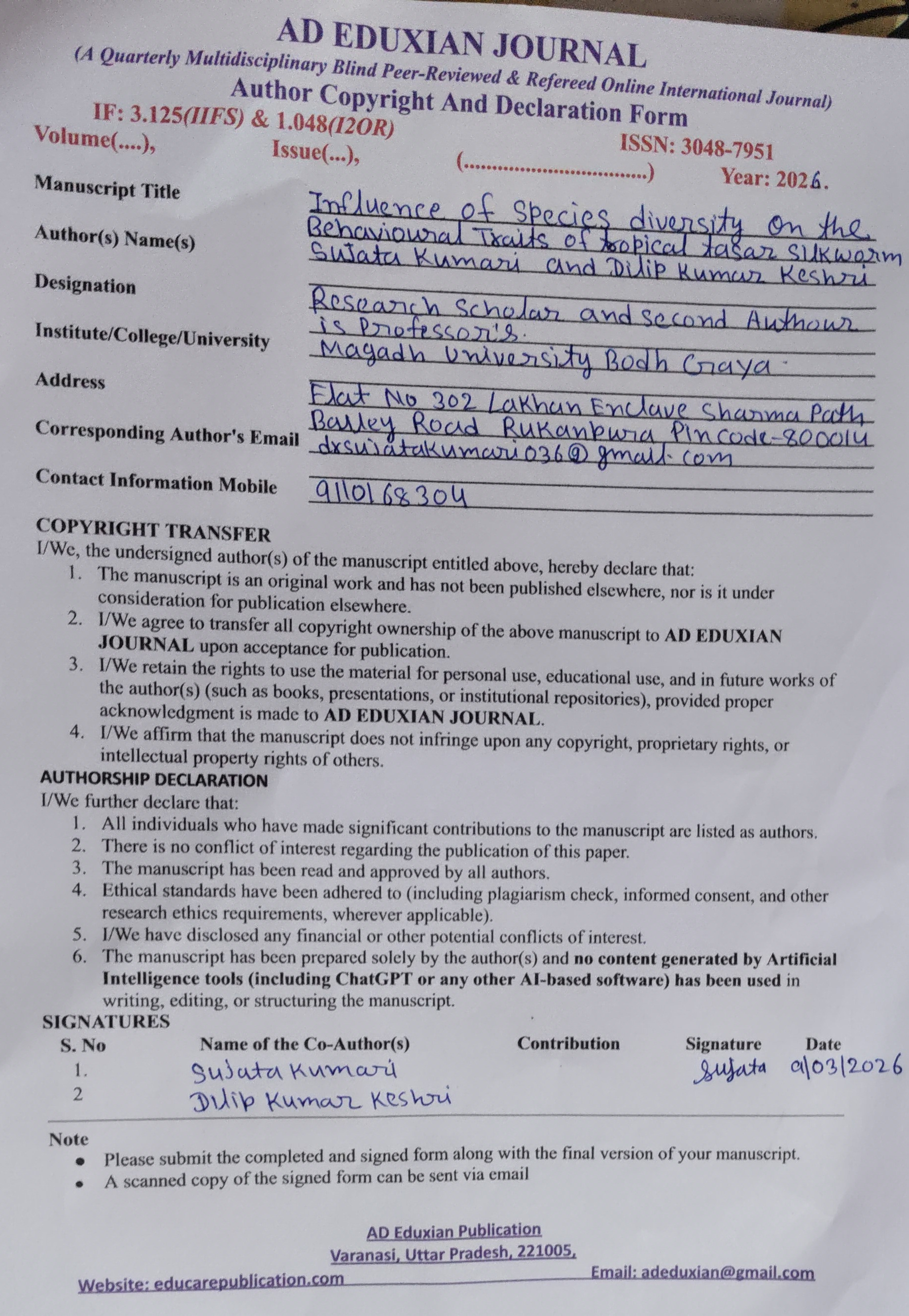
Influence of Species Diversity on the Behavioural Traits of Tropical Tasar Silkworm (Antheraea mylitta)
Acceptance: 04/02/2026
Published: 10/03/2026
Abstract
Species diversity plays an important role in shaping the behavioural responses and ecological performance of insects. The present study investigates the influence of species diversity on the behavioural traits of the tropical tasar silkworm (Antheraea mylitta). The study was conducted under natural rearing conditions in tasar-growing areas where different host plant species were available. Key behavioural parameters such as feeding behaviour, resting pattern, locomotion and host plant preference were observed and recorded during different larval instars. The results revealed significant variations in behavioural patterns in relation to species diversity and host plant availability. Larvae exhibited higher feeding frequency and activity levels in habitats with greater plant diversity. The findings suggest that species diversity positively influences the behavioural adaptability of tasar silkworms and may contribute to improved survival and growth. This study highlights the ecological significance of biodiversity in sustaining tasar sericulture and insect adaptation.
Keynote: Tasar silkworm, Antheraea mylitta, species diversity, behavioural traits, host plant, ecological adaptation
Post Views: 34
Author Name:
Sujata Kumari & Dr Dilip Kumar Keshri
Pages:
178-183
DOI Number:
10.5281/zenodo.18940746
Reference
1. Chakraborty, S., Muthulakshmi, M., Vardhini, D., Jayaprakash, P., Nagaraju, J., & Arunkumar, K. P. (2015). Genetic analysis of Indian tasar silkmoth (Antheraea mylitta) populations. Scientific Reports, 5, 15728. https://doi.org/10.1038/srep15728
2. Kar, P. K., Vijayan, K., Mohandas, T. P., Nair, C. V., Saratchandra, B., & Thangavelu, K. (2005). Genetic variability and structure of wild and semi-domestic populations of tasar silkworm (Antheraea mylitta). Genetica, 125(2–3), 173–183. https://doi.org/10.1007/s10709-005-7002-z
3. Sinha, A. K. (2011). Variability in the ecoraces of tropical tasar silkworm (Antheraea mylitta). Nature Precedings. https://doi.org/10.1038/npre.2011.6161.1
4. Gattu, R., Manda, S., & Gangupantula, S. (2017). Breeding perspective for silk quality in tropical tasar silkworm (Antheraea mylitta). Asian Journal of Biological and Life Sciences, 6(1), 347–357.
5. Komal, J., Gowrisankar, R., Vishaka, G. V., et al. (2025). Bibliometric trends and patterns in tasar silkworm (Antheraea mylitta) research (1980–2024). Frontiers in Insect Science, 5, 1533267. https://doi.org/10.3389/finsc.2025.1533267
6. Arunkumar, K. P., Metta, M., & Nagaraju, J. (2006). Molecular phylogeny of silkmoths reveals diversification of Antheraea species. Molecular Phylogenetics and Evolution, 40(2), 419–427.
7. Nagaraju, J., & Goldsmith, M. R. (2002). Silkworm genomics—progress and prospects. Current Science, 83(4), 415–425.
8. Vijayan, K., Kar, P. K., Srivastava, P. P., Nair, C. V., & Awasthi, A. K. (2007). Genetic diversity and differentiation in Indian tasar silkworm populations. Journal of Insect Science, 7(1), 1–10.
9. Reddy, R. M., & Abraham, E. G. (2010). Host plant influence on growth and silk production in tasar silkworm (Antheraea mylitta). Journal of Applied Entomology, 134(5), 404–412.
Writer Name
Sujata Kumari & Dr Dilip Kumar Keshri
Pages
178-183
DOI Numbers
10.5281/zenodo.18940746
Our Social Networks

AD EDUXIAN Publication is dedicated to advancing educational research and providing innovative learning solutions. We offer a wide range of services including publishing, editing, design, and marketing to support authors and researchers in their academic and professional endeavors.
Never miss any important news. Subscribe to our newsletter.