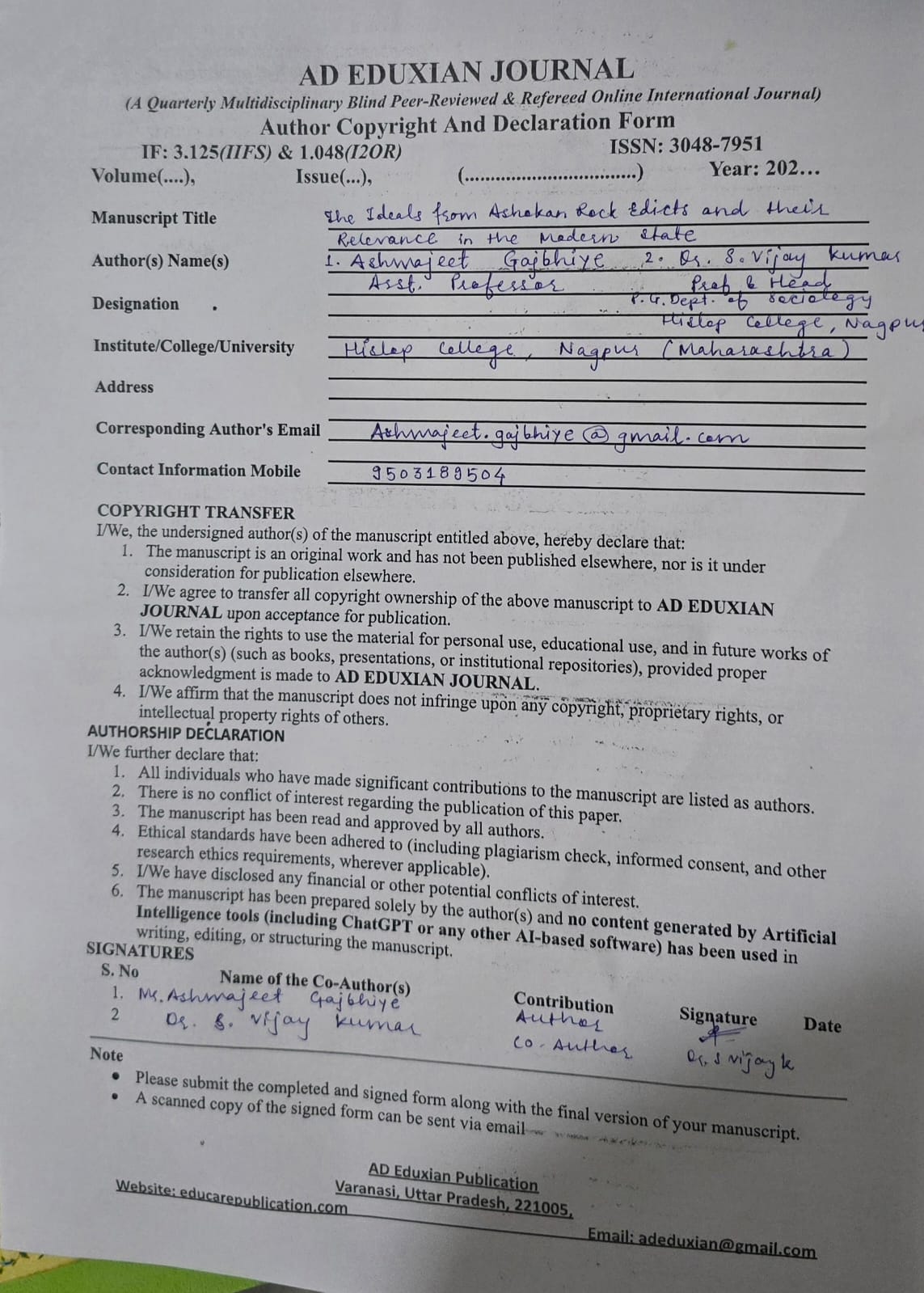
The ideals from Ashokan rock edicts and their relevance in the modern state
Acceptance: 04/05/2026
Published: 01/06/2026
Abstract
Vincent Arthur Smith has written that more than two thousand years ago, India’s first emperor had already achieved that level of scientific administrative efficiency for which his British successors later sighed in vain, and which even the Mughal emperors of the sixteenth and seventeenth centuries were never able to attain fully. The pillars and rock edicts of Emperor Ashoka are scattered across the country from one end to the other. He had rocks cut to construct caves for monks, commissioned—according to Buddhist tradition—the construction of 84,000 stupas, and erected pillars at various places whose polish and brilliance are extraordinary. The Ashokan pillars are unique examples of craftsmanship. Carved out of a single block of stone, standing about 40–50 feet high, their smooth, lustrous finish has amazed people of every age. On the Sarnath pillar, the lions display an extraordinary sense of strength and vitality; the naturalism visible in their swollen veins is unparalleled—not only in Indian sculpture but in the sculpture of the entire world. Ashoka's greatness stemmed not only from the size of his kingdom and his skill at running it, but also from his personality and the principles and objectives he aspired to preserve in his role as king.
Keynote: Emperor Ashoka, Rock Edicts, Dhamma, ideals, Ethical Governance
Post Views: 109
Author Name:
Mr. Ashwajeet Gajbhiye & Dr. S. Vijay Kumar
Pages:
275-284
DOI Number:
10.5281/zenodo.20498191
Country:
India
Orcid:
Full Article
Reference
Allen, C. (2012). Ashoka: The search for India’s lost emperor. Little, Brown Book Group.
Ashoka the Great – A journey from monarch to monk. (2015, December 15). Dolls of India. https://www.dollsofindia.com/library/ashokaemperor/
Admin. (2024, January 24). Ashoka inscription (The edicts of Ashoka) [NCERT notes – Ancient Indian History notes for UPSC]. BYJU’S. https://byjus.com/free-ias-prep/ncert-notes-ashokas-edicts/
Basham, A. L. (1954). The wonder that was India. Sidgwick & Jackson.
Basham, A. L. (1967). The wonder that was India. Sidgwick & Jackson.
Basham, A. L. (1982). Asoka and Buddhism—A reexamination. Journal of the International Association of Buddhist Studies, 5(1), 131–143.
Bhargava, R. (2023). Ashoka’s dhamma as a project of expansive moral hegemony. In Bridging Two Worlds. University of California Press.
Buddhist Publication Society. (1985). The Dhammapada: The Buddha’s path of wisdom (A. Buddharakkhita, Trans.). https://www.buddhanet.net/pdf_file/scrndhamma.pdf
Chaudhuri, H. C. (1995). Political history of ancient India: Discrepancies between Buddhist tradition and Ashokan inscriptions. In A. Seneviratna (Ed.), King Ashoka and Buddhism: Historical and literary studies. Buddhist Publication Society.
Dhammika, V. S. (1993). The edicts of King Asoka. Buddhist Publication Society.
Hultzsch, E. (1925). Inscriptions of Asoka. Oxford University Press.
Jayswal, B. K. (2025). An analysis of Ashoka’s policy of dhamma as a tool for political consolidation in the Mauryan Empire. International Journal of Social Science Research (IJSSR), 2(5), 201–204. https://www.ijssr.com/wp-content/uploads/journal/published_paper/volume-2/issue-5/IJSSR30616.pdf
Keay, J. (2000). India: A history. HarperCollins.
Khanna, A. (2020). Ashoka, the visionary: Life, legend and legacy. Bloomsbury Publishing.
Kumar, G. (2017). A study of administrative system in India: The Mouryan period. Journal of Global Values, 8(1), 211–219.
Kumar, H. (2017). The Buddha behind the Ashoka. Editor’s Desk, 2018, 158.
Lahiri, N. (2015). Ashoka in ancient India. Harvard University Press.
LotusArise. (2023, October 12). State and its elements. https://lotusarise.com/state-and-its-elements-in-political-science/
Mark, J. J., & Dharma. (2026). Ashoka the Great. World History Encyclopedia. https://www.worldhistory.org/Ashoka_the_Great/
Matsuk, A. M. (2005). A study of Ashoka Maurya of India: How his conversion to Buddhism affected the history of India (Master’s thesis). California State University, Dominguez Hills.
NCERT. (2023). Themes in Indian history – Part I. National Council of Educational Research and Training.
Officials. (n.d.). Ashoka’s administration and economy – Ancient India history notes. Prepp. https://prepp.in/news/e-492-ashokas-administration-and-economy-ancient-india-history-notes
Olivelle, P. (2013). Asokan inscriptions as text and ideology. In P. Olivelle, J. Leoshko, & H. P. Ray (Eds.), Reimagining Asoka: Memory and history (pp. 170–183). Oxford University Press.
Practice. (n.d.). Drishti IAS. https://www.drishtiias.com/mains-practice-question/question-8413/pnt
Radhakrishnan, S. (1951). Indian philosophy (Vol. 1). George Allen & Unwin.
Sahu, N. K. (1964). History of Orissa (Vol. 1). Utkal University.
Saxena, S. (2012, August 9). The Mauryas. Puratattva. https://puratattva.in/the-mauryas-11/
Sen, C. T. (2022). Ashoka and the Maurya dynasty: The history and legacy of ancient India’s greatest empire. Reaktion Books.
Sharma, R. S. (1979). Ashoka’s conversion reconsidered. Indian Historical Review, 5(1–2), 1–16.
Sharma, R. S. (2005). India’s ancient past. Oxford University Press.
Singh, M. P. (2017). Dhamma: Buddha’s and Aśoka’s. Indian Political Thought, 1.
Singh, U. (2008). A history of ancient and early medieval India: From the Stone Age to the 12th century. Pearson Education.
Smith, V. A. (1901). Asoka, the Buddhist emperor of India. Clarendon Press.
Sinha, N. C. (1994). Asoka’s dhamma.
Stoneman, R. (2021). Megasthenes’ Indica: A new translation of the fragments with commentary. Routledge.
Thapar, R. (1995). Aśoka and Buddhism as reflected in the Aśokan edicts. In A. Seneviratna (Ed.), King Aśoka and Buddhism: Historical and literary studies. Buddhist Publication Society.
Thapar, R. (1997). Ashoka and the decline of the Mauryas (Rev. ed.). Oxford University Press.
Thapar, R. (2009). Ashoka and the making of modern India. In IIC Occasional Publication No. 13. India International Centre.
Thapar, R. (2013). Aśoka and the decline of the Mauryas (3rd ed.). Oxford University Press.
The duties of Dhamma Mahamatras are explained in the major rock edict no__ A.X B. IV C.XI D.V. (n.d.). Vedantu. https://www.vedantu.com/question-answer/the-duties-of-dhamma-mahamatras-are-explained-in-class-6-social-science-cbse-5fc9b3b9455060145fcccfa7
vajiramandravi. (2026, January 2). Ashoka, dhamma, edicts and administration. Vajiram & Ravi. https://vajiramandravi.com/upsc-exam/ashoka/
Team, V. C. (2026, February 23). Kalinga war 261 BCE: Reasons, course, outcomes, impact. Vajiram & Ravi. https://vajiramandravi.com/current-affairs/kalinga-war/
Waskey, A. J. (2023). The spice trade from Kalinga War to British Raj. In Kalinga & Southeast Asia: The Civilisational Linkages (p. 49).
WisdomLib. (2025, September 1). Meaning of the name Mourya
Writer Name
Mr. Ashwajeet Gajbhiye & Dr. S. Vijay Kumar
Pages
275-284
DOI Numbers
10.5281/zenodo.20498191
Our Social Networks

AD EDUXIAN Publication is dedicated to advancing educational research and providing innovative learning solutions. We offer a wide range of services including publishing, editing, design, and marketing to support authors and researchers in their academic and professional endeavors.
Never miss any important news. Subscribe to our newsletter.