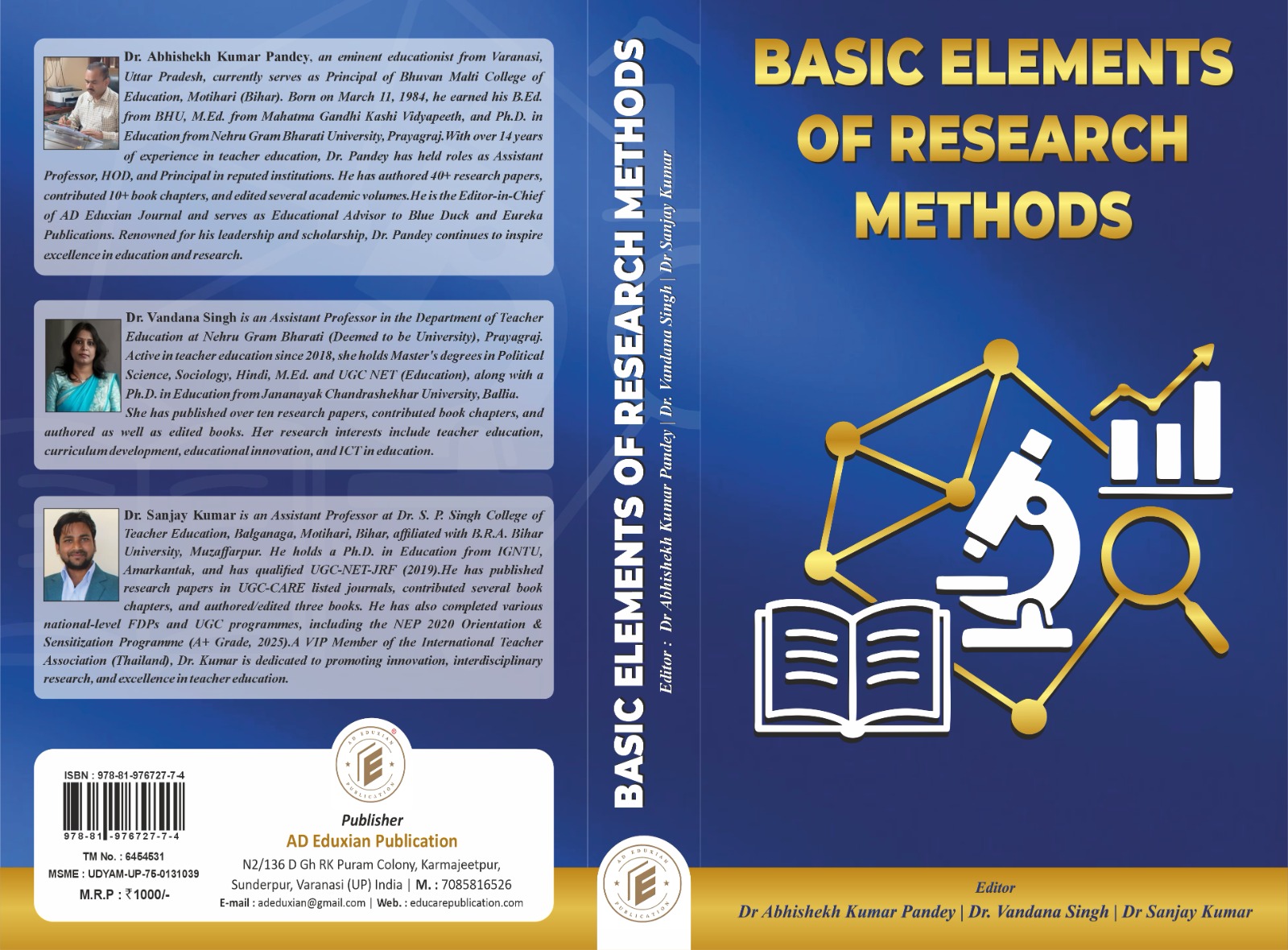
BASIC ELEMENTS OF RESEARCH METHODS (ISBN: 978-81-976727-7-4 | First Edition, 2024), is a comprehensive and systematically structured academic resource designed to provide a clear understanding of the fundamental principles and practices of research methodology. Edited by Dr. Abhishekh Kumar Pandey, Dr. Vandana Singh, and Dr. Sanjay Kumar, this book serves as an essential guide for students, educators, and research scholars across various disciplines. In the present era of knowledge expansion and academic advancement, research plays a crucial role in generating new insights, solving problems, and contributing to innovation. Recognizing this importance, the book (ISBN: 978-81-976727-7-4), published in 2024, aims to build a strong foundation in research methodology by presenting key concepts in a simple, organized, and practical manner. The book begins with an in-depth discussion of the meaning, nature, and scope of research, followed by a detailed explanation of different types of research, including qualitative, quantitative, and mixed-method approaches. It also highlights the philosophical foundations of research, such as positivism and post-positivism, enabling readers to understand the theoretical perspectives that guide research practices. A major strength of this volume lies in its step-by-step approach to the research process. It systematically guides readers through the formulation of research problems, development of objectives and hypotheses, and the significance of reviewing related literature. Furthermore, it provides a comprehensive understanding of research design, sampling techniques, and various methods of data collection, thereby equipping readers with both conceptual clarity and practical skills.
The book also emphasizes the tools and techniques used in research, such as questionnaires, interviews, observation, and scaling methods. The chapters on data analysis and interpretation cover both quantitative and qualitative approaches, including the application of statistical tools for meaningful analysis. Additionally, it offers detailed guidance on research report writing, citation styles, and ethical considerations, which are essential for maintaining academic integrity and producing high-quality research work.
Another notable feature of this book is its bilingual presentation (Hindi and English), which enhances its accessibility and usefulness for a diverse readership, particularly within the Indian academic context. The language is simple, clear, and learner-friendly, ensuring that even complex research concepts are easily understood. Published by AD Eduxian Publication (India), this First Edition (2024) is a valuable contribution to the field of research methodology. It reflects contemporary trends in research, including interdisciplinary approaches and modern analytical techniques. The book is suitable as a textbook, reference guide, and self-learning resource.
Overall, “Basic Elements of Research Methods” (ISBN: 978-81-976727-7-4) aims to develop critical thinking, analytical abilities, and a scientific approach among its readers, thereby supporting the advancement of quality research in academia and beyond.