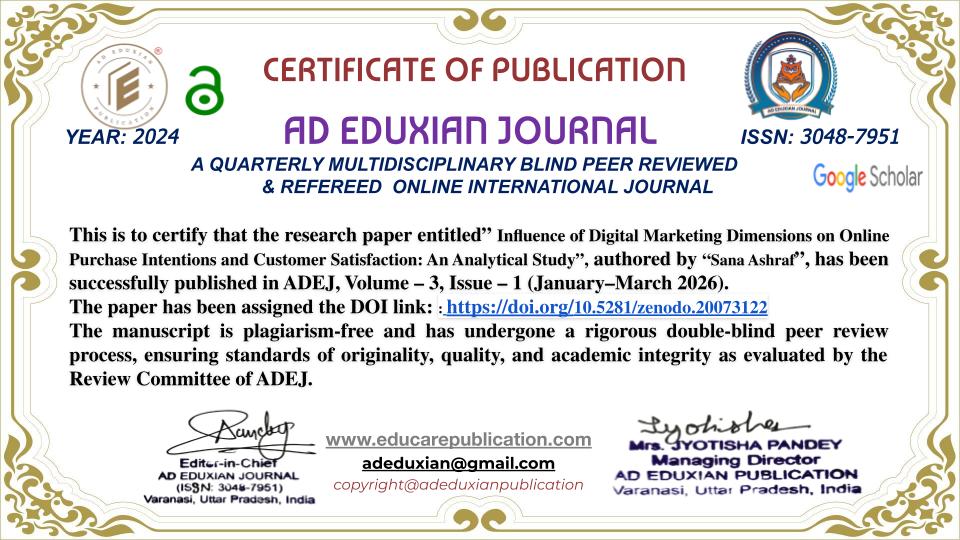
Influence of Digital Marketing Dimensions on Online Purchase Intentions and Customer Satisfaction: An Analytical Study
Acceptance: 04/01/2026
Published: 25/03/2026
Abstract
Abstract: One of the best educational approaches is value education. However, due to a number of factors, this system is only applicable in developed nations. The goal of this research is to create a training programme for primary school teachers who will be able to implement value education programmes in underdeveloped nations. Teachers hold values in addition to imparting knowledge of the principles of science and assisting in the development of particular skills and practises in a particular field. In primary schools, where the foundations of worldview are formed, this is crucial. But in the modern era, numerous factors are to blame for the deterioration of teachers' status, their subpar performance, and the loss of teaching values.
Keynote: Primary Level, Teachers, Training Programs, Values, Academic Motivation, Education System.
Post Views: 83
Author Name:
Sana Ashraf
Pages:
563-569
DOI Number:
10.5281/zenodo.20073122
Country:
Orcid:
Full Article
Reference
Clifton et. al. (2004). Faculty climate, psychosocial temperament and academic achievement, Research in Higher Education, 45(8), pp-801-828.
Michael, K. Zushiag., Susan Krans, and Whiteborn (1994). Teachers Value about Classroom Situations, Journal of Academic Publications, 47(3).
Chetham et. al. (1990). Cultures in Organizations, Oxford University Press, New York, p.3
Villar Angueto and Luis Miguel (1987). Cultures in organizations, analysis of factors influencing negative attitudes towards teacher education Nigeria, Eric Education, 126(2), pp.293-303.
Pearl Herald (1986). NCTAF meeting on the quality of preparation on strong academic preparation for teaching, Research Publications, George Washington University.
Jayanti, T. (2004). Evaluating the Effectiveness of a Curriculum-Objective Writing Developmental Teacher Training Program, Contemporary Issues in Education Research, Fourth quarter, 4.
Sinha, R.K. and Bhargav Rajni. (1993). Global Values on Teacher Learning: Improving Policy and Practice, UNESCO, IIEP, Paris.
Gupta, Arun, K. and Srinivasan, Nalini. (1990). Social Emotional School Climate, Editor, Psycholingua, Ankur Psychological Agency, 6(I).
Writer Name
Sana Ashraf
Pages
563-569
DOI Numbers
10.5281/zenodo.20073122
Our Social Networks

AD EDUXIAN Publication is dedicated to advancing educational research and providing innovative learning solutions. We offer a wide range of services including publishing, editing, design, and marketing to support authors and researchers in their academic and professional endeavors.
Never miss any important news. Subscribe to our newsletter.