The Quality of higher education in Kurdistan Region of Iraq: Current Landscape and Future Outlook
Acceptance: 04/02/2026
Published: 15/03/2026
Abstract
In the last twenty years, higher education in the Kurdistan Region of Iraq (KRI) has changed a lot due to the establishment of many private and public universities. However, the focus is now shifting from quantity to quality. This article evaluated the current status of higher education in KRI by identifying challenges, such as the lack of research output, curricula modification, faculty development, and outcomes, and alignment of education with labor market needs. It also contains the recent initiatives by the Ministry of Education, such as the implementation of national quality assurance guidelines, Bologna process adoption, and more engagement with national and international accreditation bodies. This article also has a discussion on the role of private universities in promoting the innovation and academic excellence. This study also proposed a precise roadmap to enhance research capacity, governance, student employability, and international status based on various data, existing institutional case studies, and international benchmarks. The findings underscore the importance of sustained policy support, capacity building, and global partnerships in enhancing the quality and competitiveness of higher education in the Kurdistan Region.
Keynote: Higher Education Quality, Kurdistan Region of Iraq, Academic Standards, Quality Assurance, Curriculum Reform
Post Views: 26
Author Name:
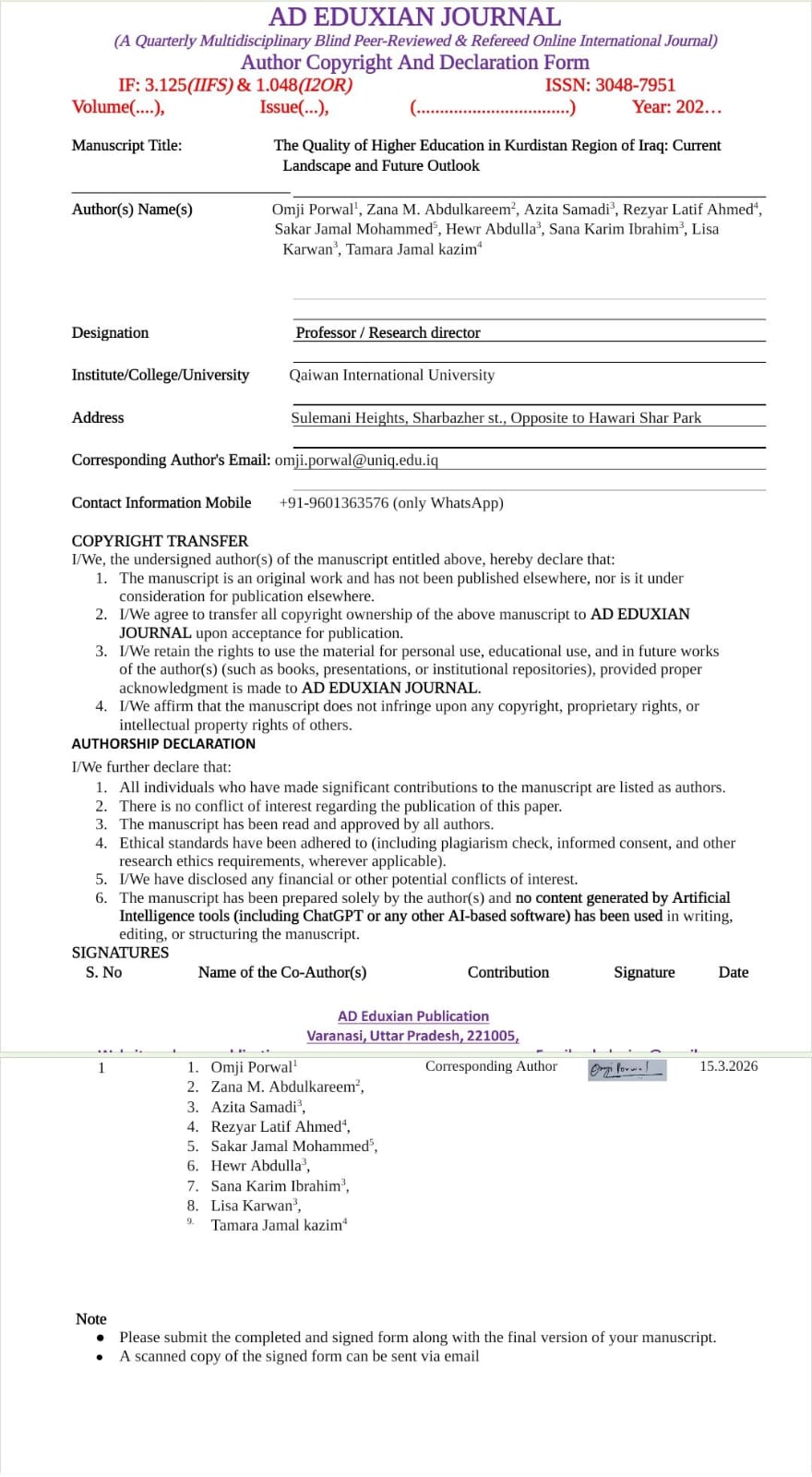
Omji Porwal , Zana M. Abdulkareem , Azita Samadi , Rezyar Latif Ahmed , Sakar Jamal Mohammed , Hewr Abdulla, Sana Karim Ibrahim, Lisa Karwan, Tamara Jamal kazim
Pages:
271-279
DOI Number:
10.5281/zenodo.19042374
Reference
1. UNESCO. Higher Education in Iraq: Needs Assessment and Roadmap for Reconstruction [Internet]. Paris: UNESCO; 2020 [cited 2025 Jul 17]. Available from: https://unesdoc.unesco.org
2. Ministry of Higher Education and Scientific Research, KRG. Annual Higher Education Statistics Report 2023 [Internet]. Erbil: MoHESR-KRG; 2023 [cited 2025 Jul 17]. Available from: https://www.mhe-krg.org
3. Al-Ali Z, Ismael Z. Education reform in the Kurdistan Region of Iraq: Achievements and challenges. Middle East Educ Rev. 2021;15(1):22–36.
4. British Council. The State of Higher Education in Iraq and the Kurdistan Region [Internet]. London: British Council; 2021 [cited 2025 Jul 17]. Available from: https://www.britishcouncil.org
5. MoHESR-KRG. Strategic Plan for Higher Education Reform 2021–2025 [Internet]. Erbil: Ministry of Higher Education and Scientific Research; 2021 [cited 2025 Jul 17].
6. World Economic Forum. The Future of Jobs Report 2023 [Internet]. Geneva: WEF; 2023 [cited 2025 Jul 17].Available from https://www.weforum.Org/reports.
7. ILO. Youth Employment and Skills Gap in Iraq [Internet]. Geneva: International Labor Organization; 2022 [cited 2025 Jul 17]. Available from: https://www.ilo.org
8. Younis R, Ahmed D. Barriers to research productivity in Iraqi Kurdistan universities. Int J Acad Res Educ Rev.. 2022;10(2):45–53.
9. University of Kurdistan Hewlêr. Annual Report 2023 [Internet]. Erbil: UKH; 2023 [cited 2025 Jul 17]. Available from: https://www.ukh.edu.krd
10. Aziz A, Mahmood K. Digital education during COVID-19 in Kurdistan Region: Challenges and innovations. Educ Technol Soc. 2021;24(3):66–75.
11. Omer, M. A., Asaad, M. M., Sofi-Karim, M., Kakakhan, M. B., Al-Zangana, S., Mohammed, O. A., … & Saeed, I. M. (2021). Academic staff’s attitude toward the Bologna process and the new pedagogy in the University of Garmian. ZANCO Journal of Pure and Applied Sciences, 33(1), 68-76.
12. Rauf, H. L., Namiq, Z., & Shareef, S. S. (2024). Practitioners’ Corner Higher education in Iraqi Kurdistan: Rethinking psychological principles in student-centred learning approach. The Independent Journal of Teaching and Learning, 19(2), 125-138.
13. Asaad, Z., & Marane, B. (2021). Evaluation of research, journals, and universities in Iraq and the Kurdistan region according to the scimago classification of administration and economics specializations: a comparative study with neighboring countries. Journals, and Universities in Iraq and the Kurdistan Region According to the Scimago Classification of Administration and Economics Specializations: A Comparative Study with Neighboring Countries (December 1, 2021). Asaad, Zeravan, and Bayar Marane, 445-484
14. Khoshnaw, F. M. (2013). Scientific research at Kurdistan universities: fundamental issues and pragmatic solutions. WIT Transactions on State-of-the-art in Science and Engineering, 77, 7-19..
15. Qolamani, K. (2022). Effectiveness of Online Teaching & Learning during Covid-19 Pandemic-Social Studies Students’ Perspective. Humanities Journal of University of Zakho, 10(3), 856-862.
16. Shabu SA. Hawler Medical University students’ perceptions of e-learning during the COVID-19 pandemic. PLoS One. 2023 Feb 23;18(2):e0281117. doi: 10.1371/journal.pone.0281117. PMID: 36821536; PMCID: PMC9949649.
17. World Economic Forum. The Future of Jobs Report 2023 [Internet]. Geneva: WEF; 2023 [cited 2025 Jul 17]. Available from: https://www.weforum.org/reports/the-future-of-jobs-report-2023/
18. British Council. Employability: A review of the literature 2012–2021 [Internet]. London: British Council; 2021 [cited 2025 Jul 17]. Available from: https://www.britishcouncil.org/research/employability-literature-review
Writer Name
Omji Porwal , Zana M. Abdulkareem , Azita Samadi , Rezyar Latif Ahmed , Sakar Jamal Mohammed , Hewr Abdulla, Sana Karim Ibrahim, Lisa Karwan, Tamara Jamal kazim
Pages
271-279
DOI Numbers
10.5281/zenodo.19042374
Our Social Networks

AD EDUXIAN Publication is dedicated to advancing educational research and providing innovative learning solutions. We offer a wide range of services including publishing, editing, design, and marketing to support authors and researchers in their academic and professional endeavors.
Never miss any important news. Subscribe to our newsletter.