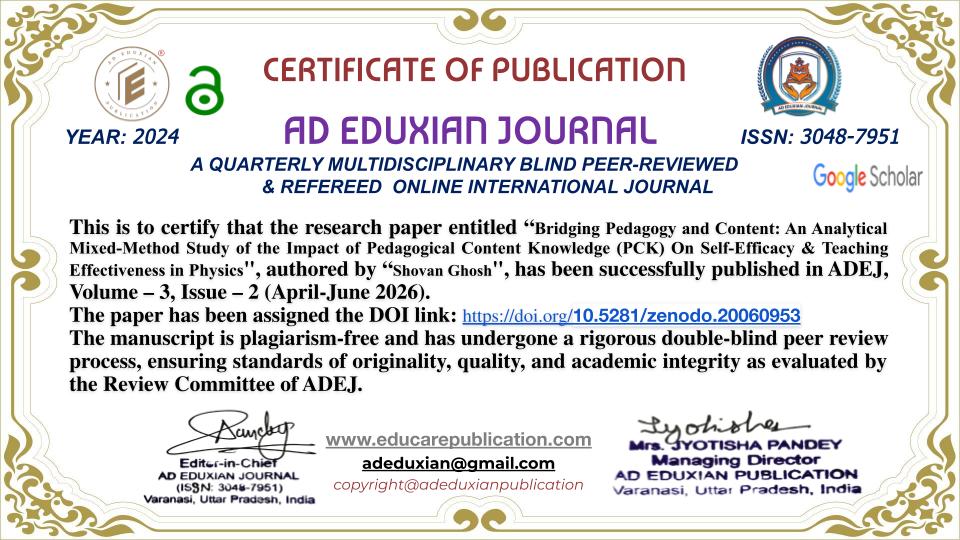
Bridging Pedagogy and Content: An Analytical Mixed-Method Study of the Impact of Pedagogical Content Knowledge (PCK) on Self-Efficacy and Teaching Effectiveness in Physics
Acceptance: 16/04/2026
Published: 07/05/2026
Abstract
The effectiveness of physics teaching is significantly influenced by teachers’ ability to integrate subject knowledge with appropriate pedagogical strategies. This integration, conceptualized as Pedagogical Content Knowledge (PCK), plays a crucial role in enhancing instructional quality and student learning outcomes. The present study examines the impact of PCK on teacher self-efficacy and teaching effectiveness in physics education. A mixed-method research design, specifically the convergent parallel model, was adopted to collect and analyze both quantitative and qualitative data. The quantitative data were collected from a sample of 120 secondary school physics teachers using standardized instruments, including a PCK scale, Teacher Self-Efficacy Scale (TSES), and Teaching Effectiveness Scale. Statistical techniques such as mean, standard deviation, Pearson correlation, regression analysis, and mediation analysis were applied. The results revealed a strong positive correlation between PCK and self-efficacy (r = 0.68) and between PCK and teaching effectiveness (r = 0.72). Regression analysis indicated that PCK significantly predicts both self-efficacy (β = 0.65, p < 0.01) and teaching effectiveness (β = 0.70, p < 0.01). Furthermore, mediation analysis demonstrated that self-efficacy partially mediates the relationship between PCK and teaching effectiveness. The qualitative findings, based on interviews and classroom observations, revealed that teachers with strong PCK demonstrate higher conceptual clarity, employ diverse instructional strategies, actively engage students, and adapt teaching methods according to learner needs. The study concludes that strengthening PCK is essential for improving both teacher confidence and teaching effectiveness in physics education.
Keynote: Pedagogical Content Knowledge, Self-Efficacy, Teaching Effectiveness, Physics Education, Mixed Methods
Post Views: 112
Author Name:
Shovan Ghosh
Pages:
152-166
DOI Number:
10.5281/zenodo.20060953
Country:
Orcid:
Full Article
Reference
Albert Bandura (1997). Self-efficacy: The exercise of control. New York: W.H. Freeman.
Lee S. Shulman (1986). Those who understand: Knowledge growth in teaching. Educational Researcher, 15(2), 4–14.
Megan Tschannen-Moran, & Anita Woolfolk Hoy (2001). Teacher efficacy: Capturing an elusive construct. Teaching and Teacher Education, 17(7), 783–805.
Sharon Magnusson, Joseph Krajcik, & Hilda Borko (1999). Nature, sources, and development of PCK. In Examining pedagogical content knowledge (pp. 95–132). Dordrecht: Springer.
Deborah L. Ball, Mark H. Thames, & Geoffrey Phelps (2008). Content knowledge for teaching. Journal of Teacher Education, 59(5), 389–407.
John Hattie (2009). Visible learning: A synthesis of over 800 meta-analyses. Routledge.
Linda Darling-Hammond (2000). Teacher quality and student achievement. Education Policy Analysis Archives, 8(1), 1–44.
Pamela L. Grossman (1990). The making of a teacher: Teacher knowledge and teacher education. Teachers College Press.
Helen Loughran, Amanda Berry, & Pamela Mulhall (2012). Understanding and developing PCK. Sense Publishers.
Eric A. Hanushek (2011). The economic value of teacher quality. Economics of Education Review, 30(3), 466–479.
Richard E. Mayer (2002). Rote versus meaningful learning. Theory Into Practice, 41(4), 226–232.
Paul A. Kirschner, John Sweller, & Richard E. Clark (2006). Why minimal guidance during instruction does not work. Educational Psychologist, 41(2), 75–86.
John W. Creswell (2014). Research design: Qualitative, quantitative, and mixed methods approaches (4th ed.). Sage Publications.
Lee S. Shulman (1987). Knowledge and teaching: Foundations of the new reform. Harvard Educational Review, 57(1), 1–22.
Gess-Newsome Julie (2015). A model of teacher professional knowledge and skill. In Re-examining PCK (pp. 28–42). Routledge.
Writer Name
Shovan Ghosh
Pages
152-166
DOI Numbers
10.5281/zenodo.20060953
Our Social Networks

AD EDUXIAN Publication is dedicated to advancing educational research and providing innovative learning solutions. We offer a wide range of services including publishing, editing, design, and marketing to support authors and researchers in their academic and professional endeavors.
Never miss any important news. Subscribe to our newsletter.